Loading…

Somewhere between ‘work hard’ and ‘just pivot,’ an entire generation realized the plan was all a fucking prank.
Grief.
The kind where you wake up on a random Tuesday and realize:
the career you were promised is a myth
the timeline you followed is now a cute little Pinterest board
the future you were building went poof
And you’re sitting there like… why do I feel sick and pissed and nostalgic, but nothing technically happened?
Exactly.
This is grief for futures that disappeared.
Futures. It hits harder because it’s invisible. There’s no one to punch. There’s no closure. There’s no “I’m proud of you for choosing you”. It’s just you, thinking of your old dream like:
“Were you ever even real?”
That.
And because there’s no big event, everyone (including you and myself) keeps trying to logic it away.
Your nervous system?
It doesn’t care if the loss was official. It cares that something you were orienting your whole life around… isn’t there anymore.
This is the kind of grief that shows up:
sadness with no event (you’re fine, you’re fine, then you’re like why am I crying in the McDonald’s drive-thru?)
anger with no target (you’re mad at capitalism, your mom, your past self, and the barista, pick a lane)
nostalgia for something that never happened (missing a life you never got to live is a special kind of mindfuck)
shame (because you should be grateful and you’re not)
mental fog (because your brain is constantly doing math that isn’t mathing)
exhaustion (because you’re dragging a coffin around like it’s a designer tote bag)
And you keep trying to label it as burnout, laziness, depression, lack of discipline, the retrograde, or the fact that you didn’t drink enough water.
No.
Sometimes it’s just, your future secretly just died.
Lazy people don’t lie awake at 3am mentally negotiating with a future that already ditched them.
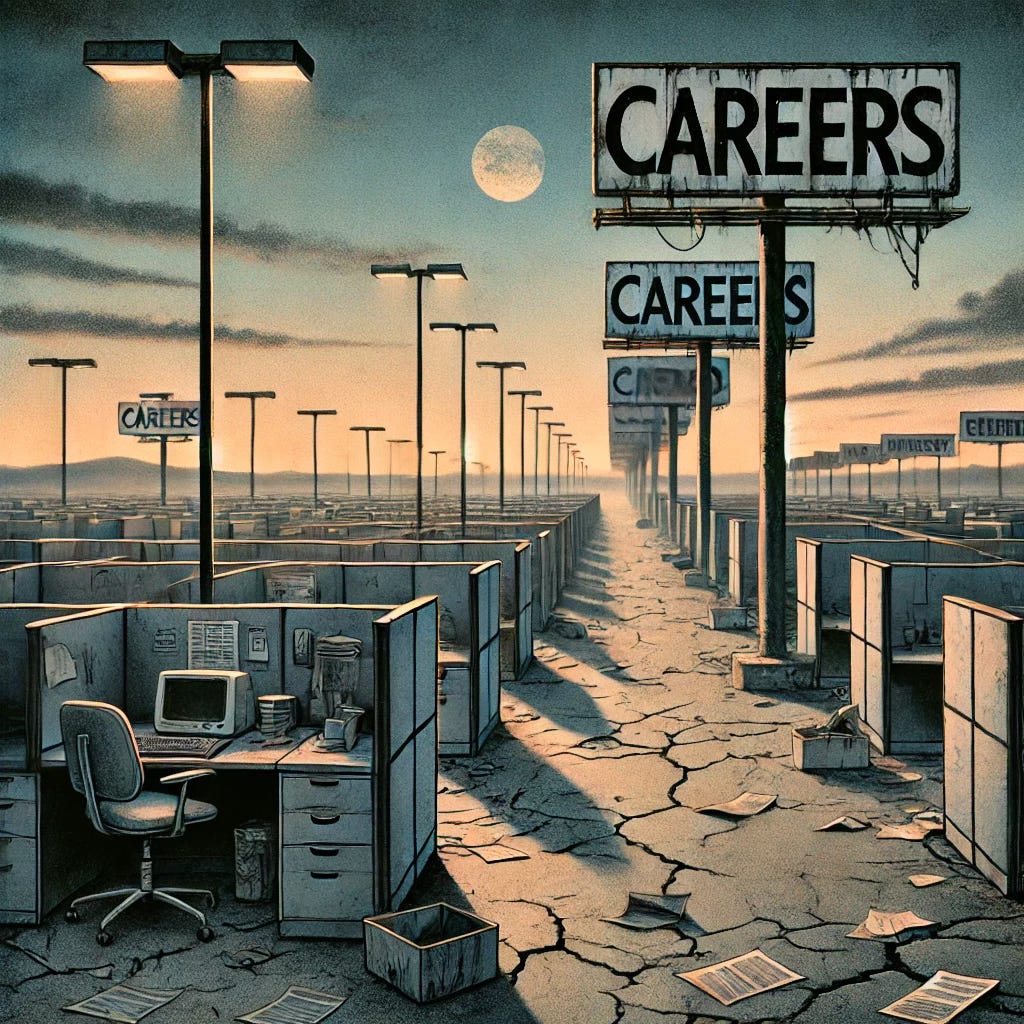
Not trying to ruin the motivational posters but:
We were sold futures based on rules that don’t exist anymore.
We were trained:
go to school
do the right thing
work hard
build a career
buy a house
stability arrives like Amazon Prime
And then the world said:
“That was a limited time offer.”
Now we’ve got entire generations grieving:
careers that got automated, outsourced, or turned into scraps
industries that collapsed or mutated
degrees that became expensive wall decor
relationships delayed by financial instability (hard to leave your spouse (or plan a future with them) when you’re dodging overdraft fees)
a normal adulthood that moved out of the neighborhood without leaving a forwarding address
This grief is structural.
And that’s why it feels so disorienting, you’re reacting normally to abnormal conditions but everyone keeps trying to treat it like a personal mindset issue.
This kind of grief is not monetized because:
there’s nothing to fix
there’s no clean before/after
there’s no satisfying villain
there’s no glow up that wraps it up in 30 days
it doesn’t resolve, it integrates
And integration doesn’t sell, because it doesn’t promise you’ll become a new you by next Tuesday.
Brands can’t package it. Influencers can’t perform it. Coaches can’t slap a funnel on it without looking like a predatory little douche bag.
What happens?
People go through it alone.
And then they blame themselves for struggling with something no one taught them.
When a person dies, society recognizes the loss. Rituals activate. People show up. The grief gets a container.
When a future dies, there’s no permission or container.
So your brain keeps it open like an unfinished tab.
And that creates this constant background stress:
“Did I fail?”
“Did I choose wrong?”
“Should I have worked harder?”
“Was I delusional?”
“Is it too late?”
“Did everyone else get it and I didn’t?”
This is how you end up emotionally buffering 24/7 doomscrolling, overworking, dissociating, researching, reorganizing your life for the 100th time.
Watching someone else ‘make it’ while you’re grieving your timeline is a special kind of psychological violence with bomb drones and hand grenades that we pretend is motivational.
Closure is a Hollywood creation.
Recognition is real.
It looks like:
“That future mattered to me.”
“I oriented my life around it.”
“I made choices based on that.”
“The map changed.”
“That loss counts.”
If you don’t recognize it, it leaks out sideways irritability, numbness, comparison, self-sabotage, random crying sesh, shame attacks, and the urge to disappear into a new identity like you just put yourself into witness protection from your own disappointment.
Future grief is recognition.
Learned helplessness is resignation.
Grief says: “Something real was lost.”
Helplessness says: “Nothing I do matters.”
If you don’t separate the two, grief quietly becomes your personality and starts making decisions for you.
Signs grief is slipping into helplessness:
you stop experimenting entirely
you narrate your life like a closed case
you assume effort is pointless before testing
you confuse realism with resignation
The goal is agency without fantasy.
Grief needs acknowledgment.
Helplessness needs interruption.
Sometimes it’s not just a career.
It’s multiple futures stacked:
“I thought I’d be secure by now.”
“I thought I’d have a family by now.”
“I thought I’d own something by now.”
“I thought I’d feel safe by now.”
“I thought hard work meant stability.”
And when those futures dissolve, it messes with your sense of reality, not just your mood.
Because your brain likes predictability.
And the world lately has been like:
“Predictability? Never heard of it.”
Here’s what I found to have helped myself handle future grief:
1) Name the future you lost
Not “my life.” Not “everything.” Get specific.
“I lost the future where I could work one job and afford rent/mortgage.”
“I lost the future where my degree guaranteed anything.”
“I lost the future where adulthood had milestones that made sense.”
“I lost the future where effort correlated with outcome.”
Specificity turns the invisible into something your brain can process.
2) Stop asking yourself if you’re allowed to grieve it
You are.
It mattered.
Even if it never happened.
You can grieve plans.
You can grieve timelines.
You can grieve versions of yourself that were trying so hard.
Anyone who doesn’t get it can go emotionally vape somewhere else.
3) Create a micro-ritual
If there’s no funeral, your body stays on alert.
Do something small but real:
write a letter to that future (even if it feels cringe just fucking do it anyway)
delete the saved tabs / vision boards / plans if they keep reopening wounds
light a candle and say to yourself “This version isn’t happening. And it hurts.”
take a walk and let your body metabolize it
Ritual is not a woo thing. It’s neurological closure.
4) Don’t force a new dream immediately
This is where people get scammed.
When a future dies, everyone panics and tries to replace it fast so they don’t feel grief.
That’s how you end up:
buying courses you don’t finish
reinventing yourself every 3 weeks
chasing someone else’s life because yours feels unstable
pretending you’re excited for the pivot
Give yourself time to be in the empty space without filling it with fake optimism.
5) Build a “reality based future”
The new future can’t be built on the old rules.
If a future requires:
pretending instability is “grind culture”
endless unpaid prep before any payoff
vague promises instead of measurable milestones
moral superiority instead of money or safety
silence about risk, cost, or failure rates
…it’s not a future.
It’s a belief system trying to recruit you.
Real futures show their math.
If you can’t see how it sustains you in the next 6-12 months, it’s denial.
A reality based future asks:
What is stable for me, not in theory?
What costs less nervous system?
What can I repeat without burning out?
What can I do consistently even when life is chaotic?
Where do I have leverage, skill, or proof I can deliver?
It’s about dreaming in a way that doesn’t gaslight you.
6) Find other people who are calling this out.
Future grief becomes poison in isolation.
You need community that tells the truth, like:
“Yeah, the timeline got nuked.”
“Yeah, that loss is real.”
“No, you’re not a lazy fuck.”
“Yes, this is happening to a lot of us.”
The opposite of invisible grief is being seen.
If you feel like you’re grieving a life you never got to live…
You’re a person who was promised a future by systems that rewrite the rules and then blame you for not adapting fast enough.
And if that pisses you off?
Good.
Anger is often grief with self respect.
While grieving a future, avoid:
rebranding yourself every 30 days
making irreversible decisions while emotionally dysregulated
chasing urgency as opportunity
mistaking someone else’s timeline for proof you’re behind
outsourcing certainty to gurus, trends, or platforms
Grief wants containment, not acceleration.
Acceleration without clarity is how people implode and then blame themselves for it.
So grieve it. Name it. Ritualize it. Integrate it.
And then build the next thing from what’s real, not what you were sold.
You need a future that doesn’t collapse every time the internet sneezes and farts at the same time.
**If you feel like you did everything you were supposed to do and still somehow ended up here tired, disoriented, and questioning whether you misunderstood the assignment. You’re grieving a future that disappeared without an event.
There’s no funeral for it. No permission slip. No moment where someone tells you, “Yes, that counted as a loss.” So your brain keeps it open like an unfinished tab, and the stress never shuts off.
This isn’t burnout. It’s not laziness. And it’s not a mindset issue.
In the paid section, I break down why this pattern exists, how to stop turning grief into self blame, and how to rebuild a future that doesn’t require gaslighting yourself to survive it.
