More Work, Same Pay? Let’s Talk About It.

This Isn’t About Blame. It’s About Building Sustainable Work, for Both Hard-Working People and Companies.
This is about patterns, not personalities.
Disclaimer: This piece is meant to shed light on common challenges in the freelance and employment world, from both sides of the table. I won’t lie, it’s a fucking rant but it’s also a reality check. If you’re a business owner, employee, or creative, this is a look at what’s really going on beneath the surface of modern work culture.
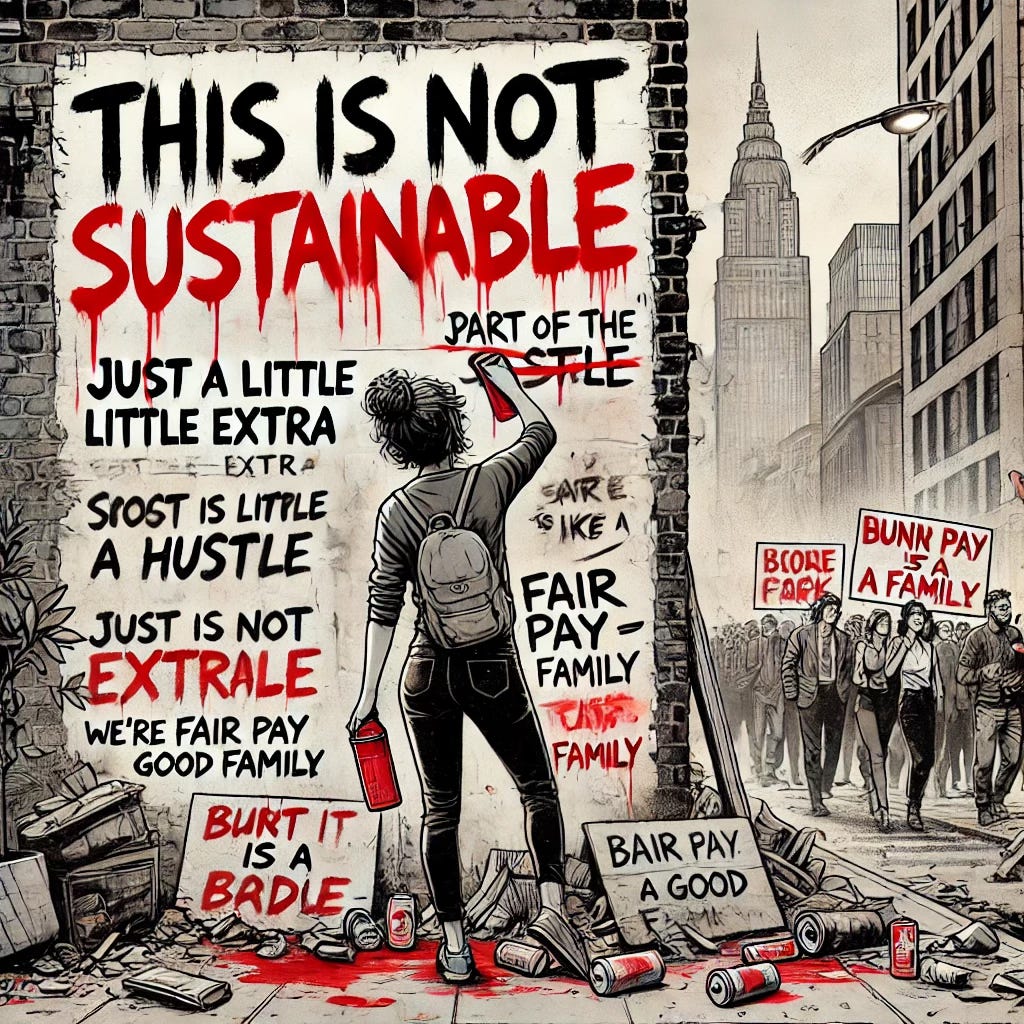
I Finally Realized Something
After years of therapy, medication, and unlearning the patterns that kept me people-pleasing my way into burnout, I’ve gained something radical: clarity.
And with that clarity, I’m starting to see the tactics, not just from clients, but from the industry. Patterns I once thought were “just how it is” are actually red flags we’ve been conditioned to accept.
Here’s the pattern:
A business hires a freelancer.
That freelancer does their job, and usually way more than what’s in the contract.
The business grows.
Instead of renegotiating, the business quietly asks for more, more hours, more responsiveness, more content, more engagement.
But still at the same rate.
Now that I can see clearly, I realize how normalized this is in every work model, not just freelance. I’ve seen it all.
Let’s Back Up for a Second
In 2019, I was living in San Diego, California (Home) making $40K/year as an Executive Assistant to NINE C-level executives. That’s not a typo. Nine. I was terrified of being replaced, so I stayed silent. I had so much anxiety bottled up I couldn’t even confront anyone, not even when my health began to decline. I just kept pushing.
So I moved to DFW, Texas looking for better opportunities. And guess what? I found one, eventually.
I landed another Executive Assistant job, and within a year I worked my ass off until I became one of the top-producing land escrow officer in Texas. From 2020 through 2023, I generated over $2 million in revenue annually for my department, alone.
Let me repeat that: I did it without a team. Without support. Without an assistant of my own.
No breaks. No boundaries. No work-life balance. Just hustle. Constant hustle.
And when I finally asked for a raise? I had to scream and curse at my boss to even get them to look at me like I mattered. I was still listed in the system as an Executive Assistant, not the top revenue-generating closer in the office. That should tell you everything.
Why didn’t I leave? Because I was scared to lose my job. I thought that being quiet meant being secure. I thought that proving myself would lead to recognition.
It didn’t.
Let’s Talk About What I Saw on the Inside
If you want to know what really burned me out, it wasn’t just the workload. It was the way leadership talked about their people behind closed doors.
As an EA, I saw it all.
Emails between executives talking about how employees were “getting greedy” for asking for raises.
How they were “entitled.”
How they should be “written up” for pushing back.
How they could just terminate the loud ones and bring in someone more “malleable.”
You thought that would work? That threatening your top talent would keep the machine running?
What actually happened was this:
You burned out your best people.
You created anxiety disorders.
You killed loyalty.
You replaced skilled, driven humans with broken ones, and now they’re gone.
That’s why the past few years have been a total shit show in corporate America.
You lost the good ones.
We left.
And we’re not coming back.
Now? We freelance. We build our own businesses. We live in vans and make art if we have to.
Because we would literally rather live on the street doing what we love than sit at a desk one more day being exploited, belittled, and underpaid.
You created this mental health crisis, business world.
You can’t call people “entitled” for asking to not lose their minds at work.
What About Freelance Work? Same Tactics, New Labels
Now I work as a freelance social media strategist. I manage multiple brands, strategize full campaigns, and engage communities from scratch. I love what I do. And I'm really good at it.
But even here, I’ve started to see the same patterns:
“Can you just be a little more active?”
“Could you respond faster to DMs?”
“Could you make another version of this content, maybe four versions, actually?”
All at the same pay.
No mention of more hours.
No scope change agreement.
No raise. Just vibes and expectations.
Let’s be honest, when you ask someone to increase platform responsiveness, create daily content, manage inboxes, AND build strategy… you’re not asking for a freelancer. You’re asking for an entire department.
The Numbers Don’t Lie
According to 2025 salary data:
Freelance social media strategists charge $50–$125/hour.
In-house roles often make $65K to $120K+ per year.
Brand managers and marketing strategists rarely work for less than $4,000/month full-time, even in small businesses. (my flat rate starts at a 1/4 of that monthly, equivalent to $20 an hour +/-)
Meanwhile, I’ve seen companies pay $200K for a marketing team to grow follower count by slightly more than I’ve achieved solo. And they don’t question that.
But I ask for a flat monthly rate that barely covers my rent, and suddenly I’m “pushing the budget”?
Come on now.
I’m feeling petty. So… What Happened to Silvergate and Lawyer’s Title?
I’ll tell you what happened.
They ignored the mental health of their employees.
They exploited their top performers.
They created toxic work environments that no one wanted to survive in.
Now?
They’re struggling.
Silvergate collapsed under its own weight. Gone. Bye.
Lawyer’s Title is… let’s just say not doing so hot. They keep selling off branches under third-party umbrellas and calling it ‘growth.’
You got greedy. You lost your people. And karma doesn’t miss.
What Do We Do Now?
If you’re a business owner reading this:
Don’t ask for more unless you’re ready to pay for more.
Don’t underestimate the power of support, transparency, and gratitude.
Understand that content doesn’t create itself. Strategy doesn’t happen in a vacuum. And burnout isn’t a personal weakness, it’s a workplace signal.
If you’re a freelancer or employee:
Track your time, even if you’re flat-rate.
Speak up when scope creeps.
Know that your mental health isn’t a luxury. It’s the most valuable asset you have.
How Do We Find a Middle Ground?
This isn’t about bashing business owners or glorifying employees, and freelancers. It’s about seeing each other clearly, and building work relationships that don’t rely on burnout or guilt.
I get it, sometimes expectations change, business needs evolve, or maybe the person you hired isn’t delivering the results you expected. That doesn’t make you a villain. But it does mean it’s time for a conversation, not just assumptions.
Here’s how both sides can approach it more fairly:
For Business Owners:
Have a scope reset meeting before asking for “more.” Is it a new platform? Faster engagement? A higher post frequency? Treat that like a new request, not an extension of the old one.
Rotate internal responsibilities before overloading one person. If you can’t afford to increase pay, maybe someone else in your company can absorb one of their older tasks so they can handle the new ones.
Be transparent about your budget and goals. Say: “We’re tight right now, but we want to grow. What’s a way we can scale this slowly, or trade off some responsibilities?”
Don’t wait until it’s tense. If you're disappointed with someone's performance, speak up early, not with punishment, but curiosity. Maybe the problem isn’t their work, it’s that you haven’t defined success clearly.
For Freelancers or Employees:
Clarify your scope regularly. Even if you're flat rate, treat your agreement like a menu, not a buffet. “Here’s what’s included. Anything outside this? Happy to discuss.”
Offer options, not ultimatums. If they need more work: “Sure! I can do X or Y at this rate, which is a priority for you right now?”
Ask to swap duties. “If I’m taking on this new platform, can someone else on your team handle inbox engagement so I don’t burn out?”
Track and present value. If you're nervous about raising your rate, show what you’ve accomplished in real numbers. Business owners love data. It’s not bragging, it’s proof.
Collaboration > Confrontation
Most of us are just trying to survive and thrive at the same time. The more honest and solution-focused we are, the more likely we are to build something sustainable together.
If you want to grow — ask.
If you want to earn more — explain.
If you’re confused or frustrated — clarify.
But don’t guilt, don’t ghost, and don’t assume.
We’re all learning how to build better systems, and that starts with having better conversations.
And where’s HR in all this? Supposed to be the bridge between employees and leadership, right? Supposed to mandate fair policies, spot burnout red flags, and say “hey, this workload isn’t sustainable.”
But let’s be honest, HR in a lot of companies isn’t built to protect people. It’s built to protect processes. You burn out? They hand you a mindfulness app and suggest yoga. You speak up? Suddenly you’re “not a culture fit.”
It’s not support. It’s damage control. And I’m fucking done pretending it works.
I’m Not Mad. I’m Just Awake.
I’m proud of the work I do.
I’m proud of the clients I help grow.
But I’m also finally proud enough of myself to say:
If you want more of me, you need to give more, too.
This has to work both ways.
So how can we do that?
How can we build working relationships where both sides thrive, not just survive?
That’s the question I’m here to ask.
And if you're still pretending it’s “just business”, well, I’ve seen what that kind of business becomes.
It becomes a ghost town of used-up people and unsustainable expectations.
And no amount of LinkedIn posts or team happy hours can fix that.
Start the conversation in your own workplace. Let’s stop normalizing burnout, and start normalizing mutual respect.
We need to talk about this.
Because I’m tired of constantly having to prove my worth to people who already see what I do every day.
It’s not fair. And I know I’m not the only one feeling this way.
Please let me know if I’m wrong. I want honest conversations about this, not echo chambers.
I’ll never hate on someone for their opinion… at least not right away.
I’ll do my best to understand all sides to this big fucking issue. So let’s talk about it, to help others (myself included) understand, too.
The world needs to see all of it to truly get it.
If we censor ourselves, we’re just repeating the same broken patterns we say we want to fix.
Let’s do better, by helping each other.
Ouch! Your analysis, talking points, and strategies are first rate. But, from up here in orbit, excruciatingly painful. I see you brilliantly tweaking the cage: oiling the hamster wheel, retrofitting nonskid on the rungs, adding handrails, and confectioning a safety net under the structure just in case one falls through the gaps.
The question I ask is, what would it take for you to break out of the working-stiff cage? You deserve a lot more. To be subservient to assholes in their asshole world is beyond humiliating and soul-crushing.
One prerequisite is to break the bonds of money dependance. That's a tough one when we're caught in the quicksand attached to the financialized umbilical cord. However, it's doable. The price is high. But, ultimately, what's the other option?
Low recognition, low affirmation, low pay, while doing more, more, more, simultaneously handling super complex customer relations —> I‘m on sabbatical now.
Nothing is more important than your health — as you wrote.
Thanks for the rant, Mariah 😁