Sensemaking: Part 7
Your Brain on the Internet

This article is part of the Sensemaking Series, an ongoing exploration of how modern information systems shape perception, interpretation, cognition, and public understanding.
The Sensemaking Series
Part 1 - Reality Is Now Open Source
Part 2 - Why People Stopped Listening to Experts
Part 3 - The System Deciding Which Reality You See
Part 4 - The Internet Is Now an Outrage Machine
Part 5 - Because Someone Has to Explain This Shit
Part 6 - Same Events. Different Worlds.
Part 7 - Your Brain on the Internet
Part 8 - How to Recognize Signal
Part 9 - Sensemaking
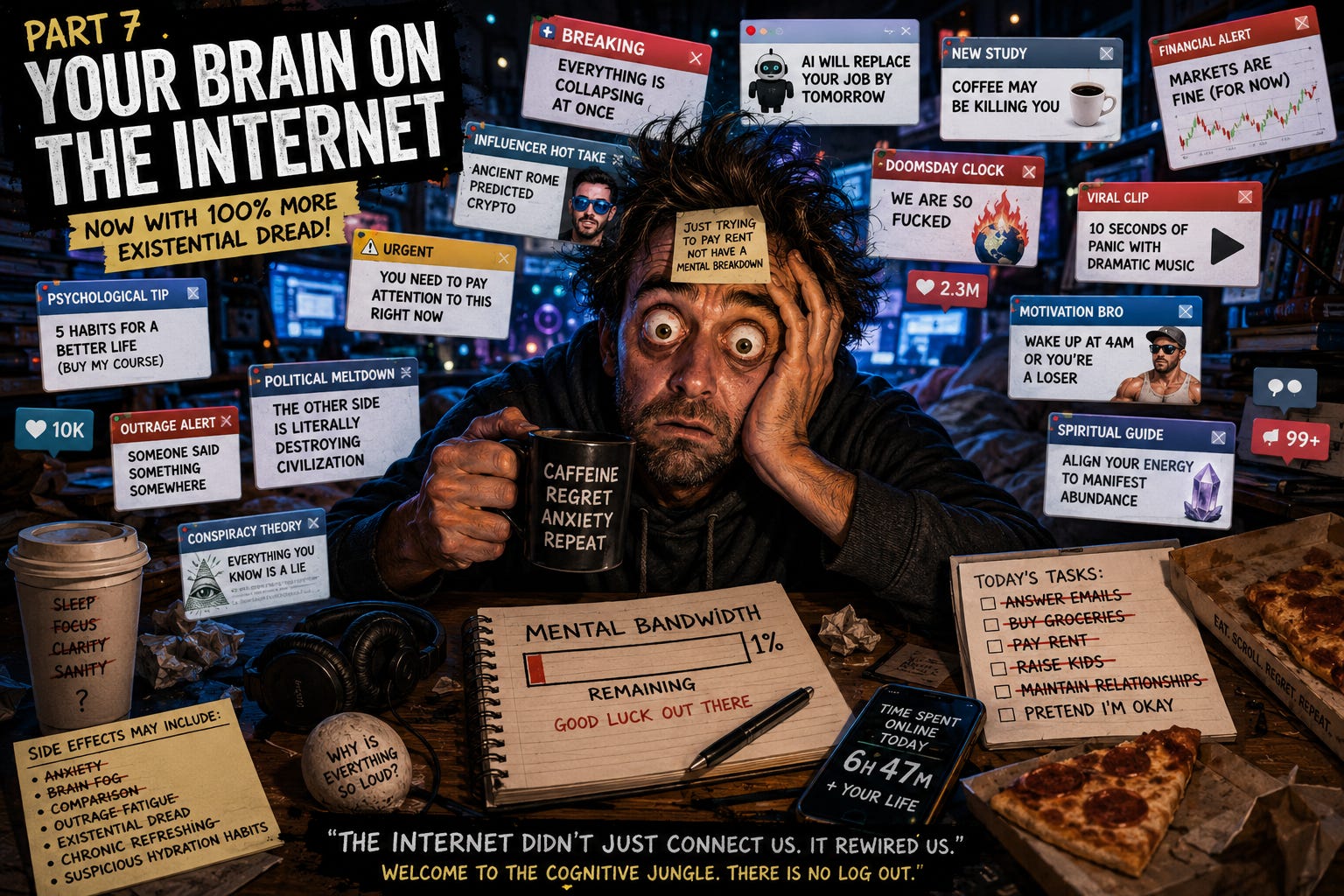
The human brain is processing way too much shit now and we’re still expected to function like this is a psychologically stable fucking environment.
The updates never stop. The interpretations never stop. There’s always another crisis, another warning, another technological breakthrough, another collapse prediction, another emotionally unwell person on the internet aggressively explaining what’s “really happening” using a chart nobody has the energy to fact check anymore.
Inside all of that, people are still trying to answer emails, buy groceries, pay rent, raise kids, maintain relationships, and somehow continue functioning like this arrangement is remotely normal.
Most people describe this sensation personally. Burnout. Anxiety. Mental fatigue. Attention problems. Overstimulation. Some of it is real. But some of what people are experiencing may not be individual at all. It may be structural.
Earlier in this series, we explored what happened to information systems. Institutions lost their monopoly on interpretation. Algorithms began shaping visibility. Narratives started competing for emotional dominance. Shared reality fragmented into parallel informational systems. Communities formed around interpreters rather than official authorities. Meaning stopped arriving from centralized systems and began emerging through chaotic networks of competing explanations instead.
Now another consequence is becoming difficult to ignore.
The internet is no longer simply a communication tool. It has become a cognitive architecture, and the human nervous system is adapting to it in real time.
For almost all of human history, the brain operated inside relatively stable informational conditions. Smaller communities. Slower cultural change. Limited social comparison. A manageable number of things worth worrying about before someone eventually needed to go survive winter or get kicked by livestock.
Human cognition evolved for manageable context, not uninterrupted global exposure.
The average person now absorbs more emotionally charged interpretation before breakfast than earlier societies encountered in weeks. Economic instability arrives beside celebrity drama. Geopolitical conflict appears beside AI predictions, financial panic, productivity culture, algorithmic outrage, psychological advice, social collapse theories, political tribalism, and somebody on YouTube confidently explaining how ancient Rome predicted cryptocurrency while standing in front of LED lights glowing radioactive blue.
An absolutely magnificent development for the species.
The nervous system evolved for local survival, recoverable attention, finite complexity, and networks where the psychological atmosphere occasionally stopped vibrating long enough for us human beings to mentally reset.
Now the machine never stops moving.
The informational ecosystem follows everyone everywhere. Into bed. Into relationships. Into meals. Into silence. Into moments that once belonged to recovery. There is no clear boundary anymore between being connected to the network and simply existing inside modern life. The machine accompanies people constantly like an emotionally unstable flight attendant narrating turbulence via the cabin speaker.
And because the informational climate continuously updates, many have developed a condition that resembles permanent cognitive vigilance. Not consciously. Structurally.
People refresh feeds because the situation might have changed. Markets might collapse. Politics might escalate. Artificial intelligence might replace another industry overnight. Some cultural controversy might suddenly become morally mandatory to react to within a few minutes or risk temporary exile from the digital village square.
The system rewards monitoring behavior, so the mind adapts around monitoring behavior.
Many now exist in a low grade anticipatory state that resembles waiting for an alert that never arrives but never fully disappears either. The sensation becomes obvious once you notice how many no longer feel psychologically off duty. Even moments of rest now contain background processing.
Historically, humans experienced clearer informational boundaries. News cycles paused. Conversations ended. Events unfolded slower than the emotional reactions surrounding them. That distance mattered more than most realized.
The current environment eliminated much of the space between an event occurring and millions emotionally reacting to it. Tragedies, conflicts, economic instability, cultural panic, technological disruption, and social outrage now arrive instantly, continuously, and directly into perception before reflection fully forms.
The brain evolved around cycles of focus, resolution, and recovery. The internet flattened those cycles into permanence.
Information no longer concludes. Emotional atmosphere no longer dissipates before the next wave arrives. Narratives no longer settle long enough for people to metabolize them properly before another crisis enters the feed wrapped in dramatic music and the phrase “you need to pay attention to this immediately.”
Most people are now carrying unresolved informational residue from dozens of situations simultaneously while pretending this is a perfectly healthy way for a primate to experience consciousness.
Which helps explain why so many feel exhausted in ways sleep does not fully repair.
The fatigue many describe is not always physical depletion. Sometimes it is continuous unresolved processing.
