Sensemaking: Part 9
How We Try Not To Get Lost

This article is part of the Sensemaking Series, an ongoing exploration of how modern information systems shape perception, interpretation, cognition, and public understanding.
The Sensemaking Series
Part 1 - Reality Is Now Open Source
Part 2 - Why People Stopped Listening to Experts
Part 3 - The System Deciding Which Reality You See
Part 4 - The Internet Is Now an Outrage Machine
Part 5 - Because Someone Has to Explain This Shit
Part 6 - Same Events. Different Worlds.
Part 7 - Your Brain on the Internet
Part 8 - How To Recognize Signal
Part 9 - How We Try Not To Get Lost
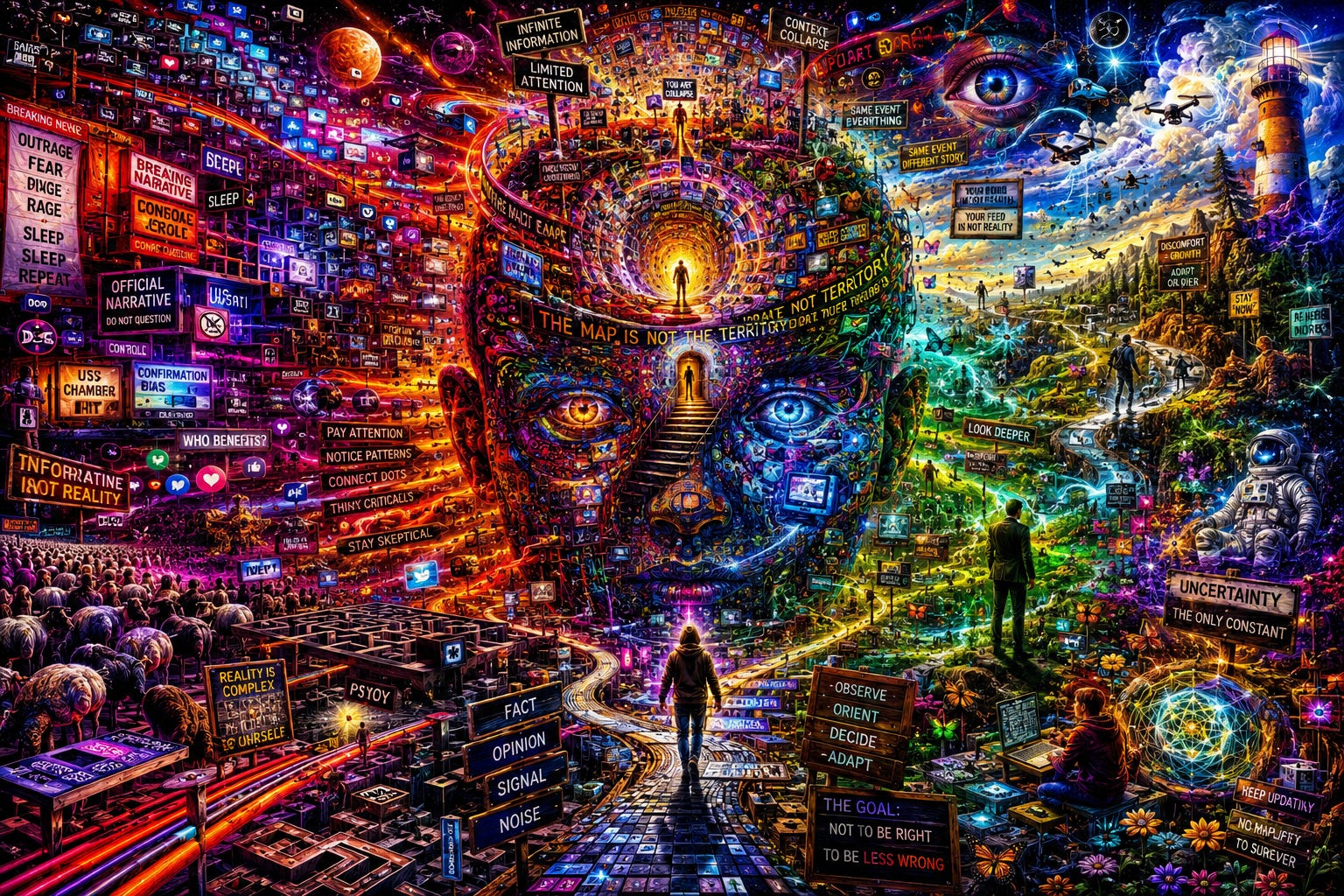
For the last eight parts we’ve been pulling apart the machine.
How information and trust changed. How algorithms shape visibility. How outrage spreads. How narratives compete. How the internet became a cognitive environment. How signal gets buried underneath spectacle, and how we are attempting to navigate all of it.
Underneath every article in this series was a much bigger question.
What exactly are we doing when we try to understand reality?
That process has a name. Sensemaking. Strange thing is that most of us don’t realize we’re doing it. We think we’re forming opinions, gathering information, and deciding what we believe. What we’re actually doing is building models. Tiny portable versions of reality that fit inside our heads.
Reality itself is far too large, far too complicated, far too incomplete, and far too chaotic.
No one can directly process the entire economy. No one can directly process every institution, technology, incentive, cultural shift, and system.
So the brain does what it does best. It simplifies, compresses, and creates maps. Those maps help us navigate the world. Sensemaking is the process of building them.
The map is not reality. The map is an attempt. A useful approximation. A working model. A guess that survives contact with reality long enough to remain useful.
The problem is that we eventually forget the difference. The map starts feeling like reality itself. Which may explain a surprising amount of human behavior. Most arguments aren’t actually about reality. They’re arguments between competing maps. Two people witness the same event. One sees economic decline. Another sees technological progress. One sees institutional failure. Another sees adaptation. One sees collapse. Another sees transition.
The event is identical. The maps are different. Once you realize that, a lot of modern confusion starts making sense. The internet didn’t just create more information. It created more maps.
Millions of them. Competing. Overlapping. Contradicting one another. All attempting to explain the same reality.
Which means the challenge isn’t deciding whether we have maps. Everyone does. The challenge is deciding which maps are useful. Some maps work, and some don’t. Some maps explain reality accurately enough to help us navigate. Others completely distort it.
Some maps were useful ten years ago but no longer reflect current conditions. Some maps were never particularly good in the first place. The difficulty is that bad maps often feel just as convincing as good ones. Especially in environments flooded with certainty.
The world changes before the map does.
Reality updates first. Explanations update later. Institutions update later. Narratives update later. Public consensus updates later still.
The map is always chasing the territory.
