The Pattern Project: Case Study #1
What are we noticing?

THANK YOU to everyone who participated in this little experiment of mine.
This was way cooler than I expected, and judging by the messages, comments, and requests for more, this won’t be the last Pattern Project.
Links to all the questions posted are listed at the end of this article.
This article will unlock for everyone in 7 days.
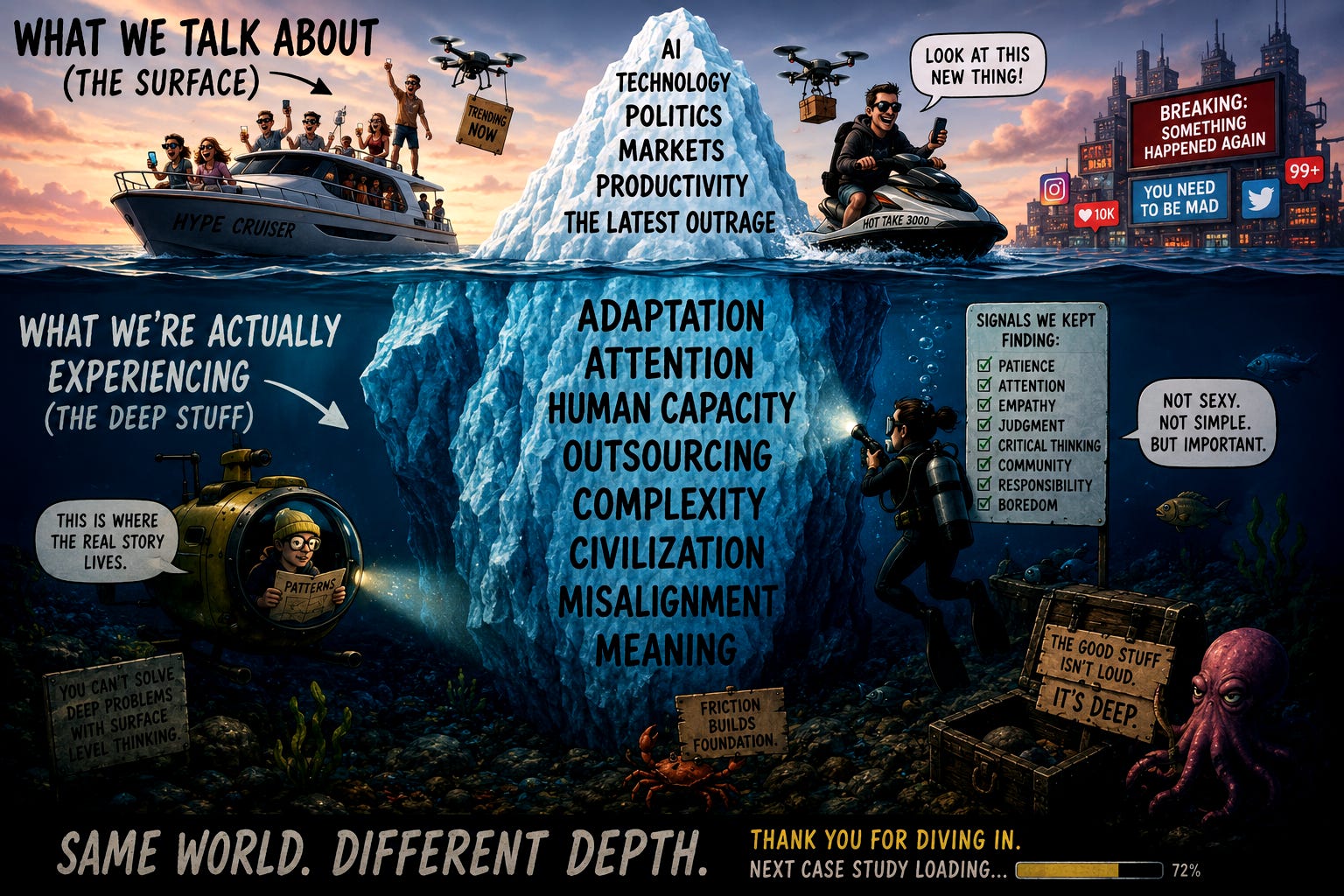
For the last two weeks I’ve been asking a series of questions.
I wanted to see what y’all noticed when nobody handed you the conclusion first.
The questions seemed completely unrelated.
What skill would someone think you’re trying to master?
What human ability is becoming optional?
What skill are we losing?
What is becoming normal?
What have we stopped teaching?
What should never be outsourced?
What do we know too much about?
What does society reward?
What does civilization keep trying to treat instead of understand?
And they appeared to be all over the place.
I was interested in the overlap.
I wanted to know what complete strangers would notice on their own if nobody told them where to look.
I expected discussions about technology, arguments about politics, and debates about AI.
Instead y’all kept talking about patience, attention, critical thinking, judgment, empathy, community, responsibility, and boredom.
Not at all where I expected this to go.
Nobody coordinated, nobody knew what future questions were coming, nobody knew what patterns I was looking for.
Yet complete strangers kept independently pointing toward the same concerns.
After two weeks and hundreds of responses, I started to suspect that this project wasn’t revealing opinions.
It was revealing perceptions. Not what we believe, but what we feel changing.
Beliefs tend to divide us.
Perceptions often reveal the environment they share.
What emerged was a human story.
A story about what happens when environments change faster than the habits that once helped us navigate them.
A story about what many of us think we’re gaining.
A story about what many of us fear we’re losing.
Most importantly, a story about the possibility that modern life isn’t making us stupid, lazy, distracted, anxious, dependent, or disconnected.
It could simply be changing the conditions under which those things emerge.
Judging from the responses, a lot of us seem to be noticing too.
The questions changed.
The answers continued to rhyme.
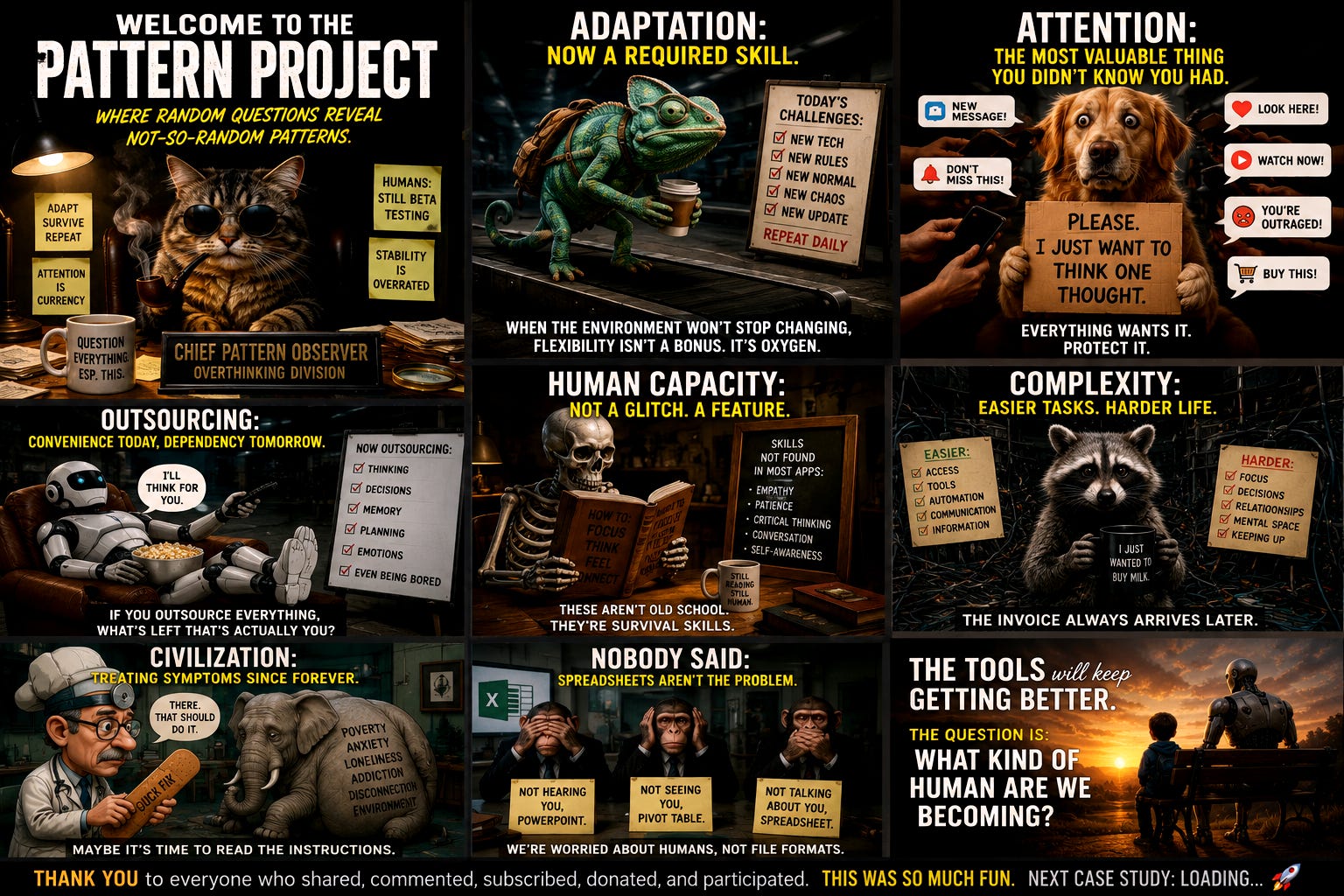
The Adaptation Pattern
The first thing that surprised me was how few answered questions the way I expected them to.
When I asked:
“What skill would someone think you’re trying to master?”
I expected answers like:
Writing. Marketing. Coding. Sales. Investing.
The usual collection of modern adult side quests.
Instead I got answers like:
“Trying hard not to go totally insane.”
“Peace of mind.”
“Living well.”
“Trying to survive without sleep while building a business.”
“Learning how to become reliable through consistency rather than intention.”
Immediately it all felt different.
Most were describing navigation.
The dominant skill was adaptation.
That pattern showed up again when I asked:
“What personality traits does the modern world pay people extra for?”
The strongest responses weren’t about intelligence, credentials, or technical knowledge.
Y’all kept talking about the ability to stay calm when nobody knows what they’re doing. Judgment under pressure. Problem solving. Learning new things. The ability to figure it out. Adaptation itself, which kept showing up everywhere.
Even when I asked:
“What skill has become mandatory for modern life?”
Most answered:
Attention. Pattern recognition. Discernment. Agility. Change management. Boundaries. Navigation skills.
Raising an interesting possibility.
Maybe one of the defining experiences of modern life is that we’re spending less time mastering stable environments and more time adapting to changing ones.
Previous generations often spent decades operating within relatively consistent systems.
A person learned a profession, a town, an industry, a social structure, a technology, and then spent years refining their competence inside it.
Today many of us are adapting to:
Changing technologies, workplaces, economies, media environments, social norms, expectations, definitions of success, often all of those simultaneously, and whatever fresh chaos got invented while we were sleeping.
The challenge is:
“How do I keep up with whatever this becomes next?”
That could explain why so many responses focused on adaptability rather than expertise, because expertise assumes stability, adaptation assumes change, and if the comments are any indication, a lot of us seem to feel like we’re living in environments where change comes faster than certainty.
An interesting part is that nobody seemed particularly excited about this. Nobody was excited for endless adaptation. Y’all were describing it, almost like weather.
As if flexibility, resilience, judgment, and the ability to figure things out have become survival skills.
The environment increasingly demands them.
Most of us are not merely trying to master things, we’re trying to stay oriented while the landscape keeps moving.
If adaptation has become a survival skill, then stability has become a luxury.
Trying hard not to go totally fucking insane.
The Attention Pattern
The second thing that started showing up everywhere was attention.
It showed up sideways.
When I asked:
“What skill do you think people are currently losing without realizing how valuable it was?”
The answers looked like this:
Critical thinking. The ability to be bored. Being present. Reading. Conversation. Curiosity. Patience.
Those seem like completely different answers, until you realize all of them require attention.
Then I asked:
“What do you think we know too much about now?”
The responses were:
Each other. Everyone else. Shortcuts. Substack growth. Other people’s lives. Inconsequential details, and Nothing.
A funny answer because several of you somehow arrived at it independently.
We know too much about nothing.
Might be one of the strongest answers in the entire project.
A surprising number of you appeared to be pointing at the same thing.
Information isn’t scarce anymore.
Attention is.
Then I asked:
“What skill has become mandatory for modern life?”
One of the shortest responses was:
“Attention.”
No explanation needed.
Attention used to happen on its own. Now it feels like everyone is fighting to keep it.
Like a small village under constant attack.
Every app, platform, notification, and every algorithm wants it.
Half the internet appears to wake up every day and ask:
“How do we become this person’s problem today?”
Then acts shocked when nobody can focus.
Several brought up boredom repeatedly throughout this project.
Interesting, because boredom spent most of human history being treated like a problem.
Something valuable that disappeared while the rest of us were looking somewhere else.
The more responses I read, the less convinced I became that anyone is actually worried about information.
Most seemed more worried about their relationship with information.
Many seemed to be saying:
“We need fewer things fighting for our attention.”
A completely different problem, and it showed up over and over again.
Questions about skills became discussions about focus.
Questions about technology became discussions about distraction.
Questions about modern life became discussions about overwhelm.
Maybe one of the defining challenges of modern life isn’t acquiring information but is deciding what deserves your attention in the first place.
If adaptation was the first pattern that emerged from this project, attention could be the thing adaptation depends on.
It’s hard to adapt when you can’t focus.
It’s hard to think when you’re constantly interrupted.
It’s hard to notice patterns when you’re drowning.
Based on the responses, a lot of you seem to feel like you're spending more and more energy protecting your attention from the environment around you.
A strange thing for a civilization to accidentally turn into a survival skill.
A civilization that cannot protect attention eventually struggles to protect anything else.
The ability to be bored.
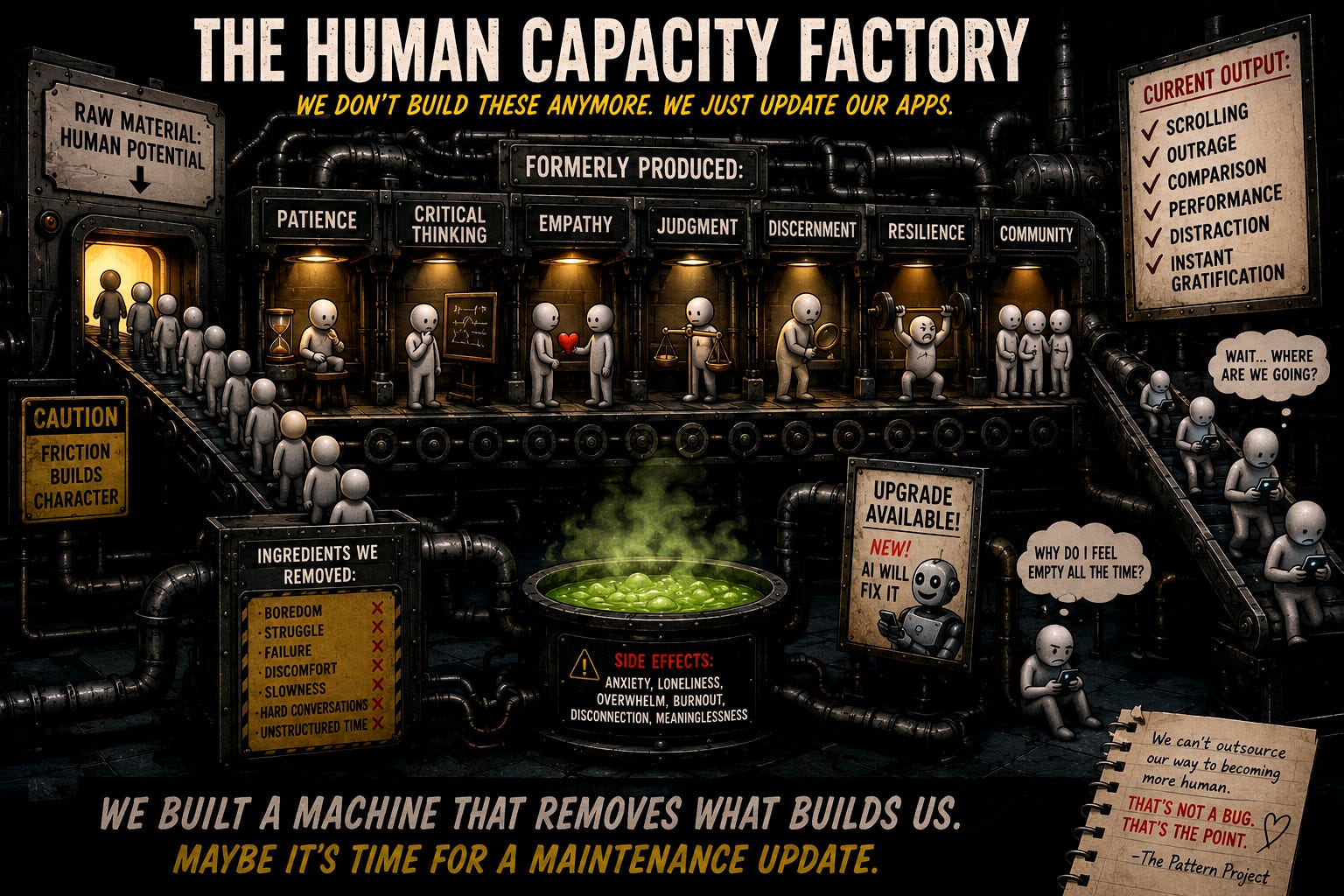
The Human Capacity Pattern
This is where things started getting difficult to ignore, by this point I had asked a lot of different questions.
Different topics, angles, and wording.
Yet the same answers kept finding their way back into the conversation.
When I asked:
“What human ability do you think future generations will find strange that we once had to learn?”
The conversation pointed toward:
Empathy. Patience. Reading. Writing. Neighborly love. Keeping silent. Memory. Delayed gratification.
Then I asked:
“What skill do you think people are currently losing without realizing how valuable it was?”
The most common answers were:
Critical thinking. Curiosity. Conversation. The ability to be bored. Reading others. Acceptance. Patience.
Then I asked:
“What have we stopped teaching?”
What kept showing up was:
Critical thinking. How to think. Emotional intelligence. Humility. Respect. Civility. Truth matters. Community awareness. Patience.
Almost nobody was talking about technical skills.
Very few of you were saying:
Coding. Engineering. Accounting. Data analysis. Project management.
Nobody was panicking about a shortage of spreadsheet proficiency.
Instead you kept returning to things that are much harder to measure.
Patience. Empathy. Judgment. Humility. Conversation. Understanding. Community.
Raising an uncomfortable possibility.
What if we aren’t primarily worried about losing knowledge?
What if they’re worried about losing the capacities that make knowledge useful?
Information kept showing up throughout this project, but information never felt like the thing most of you were worried about.
If anything, several of you argued we may already have too much of it.
The concern wasn’t knowledge. The concern was what happens when attention, judgment, critical thinking, patience, and empathy begin to erode at the same time.
Many of these capacities depend on one another.
Patience supports attention.
Attention supports understanding.
Understanding supports judgment.
Judgment supports decision making.
Empathy supports relationships.
Relationships support community.
Pull hard enough on one thread and eventually the whole thing starts moving.
One of the most surprising discoveries in this project is how often y'all answered questions about modern society with answers about human beings.
I asked about convenience, and you answered with patience.
I asked about skills, and you answered empathy.
I asked about modern life, and you answered boredom.
I asked about civilization, and you answered judgment.
That’s not what I expected.
Hilarious.
It’s like I kept asking questions about the vehicle and everybody wanted to talk about the driver.
The more responses I read, the more it felt like y’all weren’t describing a technological problem.
Most of you were describing a human capacity problem.
Because a surprising number of you seem to feel that some of the traits we depend on most are no longer being actively developed, protected, or reinforced.
And before anybody starts panicking, that doesn’t necessarily mean they’re disappearing.
It may simply mean we notice them most when they’re missing.
Nobody talks much about oxygen until somebody starts removing it from the room.
The same thing may be true of patience, empathy, critical thinking, conversation, or community.
Explains why these answers kept resurfacing.
They keep encountering the same absences.
The ability to observe without a narrative.
The traits y’all kept naming weren’t productive traits.
They were foundational traits.
The Outsourcing Pattern
If there was one pattern that kept sneaking into almost every question, it was outsourcing.
Not just outsourcing labor and tasks, but also outsourcing responsibility, judgment, thinking, attention, inconvenience.
Interesting because I never asked:
“What are we outsourcing?”
Yet you kept answering it anyway.
When I asked:
“What human ability feels risky to outsource completely?”
The answers were surprisingly consistent.
Judgment. Critical thinking. Empathy. Conscience. Creativity. The ability to process emotions. Reading body language. Hope. Human connection.
One response stood out:
Machines can inform judgment, sharpen judgment, and prepare options. But once judgment is outsourced completely, responsibility usually follows.
That response hit me hard. This explains a lot of the other answers.
Most of you didn’t seem worried about the existence of the tools.
You seemed worried about what happens when the tool becomes the decision maker.
Then I asked:
“What should never be outsourced?”
Once again you drifted toward the same territory, human capacities.
The stuff that sits at the center of being a person. The things we use to decide, interpret, relate, understand.
Becoming even more interesting when paired with another question:
“Every convenience solves a problem. What new dependency does it create?”
One response pointed out that as more household functions became outsourced, fewer opportunities remained for us to learn the skills that once came with them.
Not just practical skills. Character building skills, responsibility, patience, self reliance, competence.
An observation that kept bouncing around my head.
It feels connected to several other answers throughout the project.
We repeatedly talked about:
Patience. Boredom. Practice. Conversation. Critical thinking. Attention.
Things that are often developed through friction and civilization has become exceptionally good at removing friction.
To be clear, this isn’t an argument against convenience.
I enjoy indoor plumbing, and so I would like to keep it.
What you seemed to be questioning was the possibility that every convenience removes something in addition to the problem it solves.
Sometimes that’s a good trade.
Sometimes it’s not.
Sometimes we don’t notice the trade until years later.
One of the most interesting responses suggested that inconvenience may have functioned as a training environment.
An idea that showed up repeatedly throughout this project.
The ability to wait, to focus, to tolerate boredom, to solve problems, and to figure things out.
Many of the capacities you fear losing are the exact capacities friction helped develop.
Awkward, because modern civilization is basically a giant machine designed to eliminate friction.
Which means we’re left with a question.
What happens when a civilization becomes incredibly efficient at removing the conditions that once helped develop the skills we value most?
I don’t know the answer, the comments don’t know the answer, but a surprising number of you seem to suspect we’re already running that experiment.
And if that’s true, it explains why so many responses sounded less concerned about technology itself and more concerned about what happens when we gradually stop exercising certain human capacities.
After all, muscles don’t disappear because they’re bad, they disappear because they’re no longer required, and judging from the responses, a lot of y’all are trying to figure out which human muscles modern life is asking us to stop utilizing.
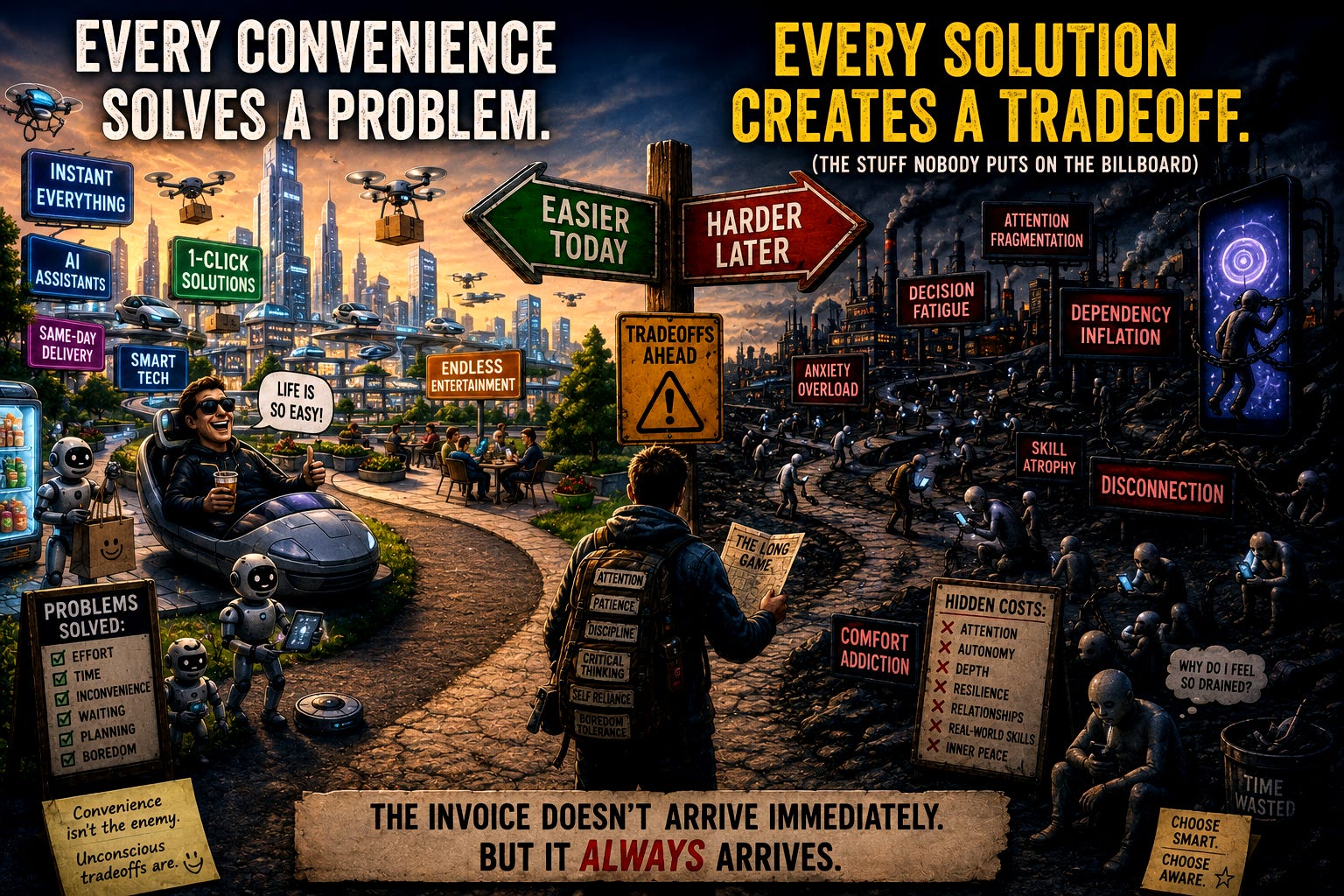
The Complexity Pattern
One of the strangest discoveries from this project was how often most of you described complexity without actually using the word.
When I asked:
“At what point does removing obstacles start creating new problems?”
The overwhelming response was:
Immediately.
Again and again, people pointed toward the idea that solving one problem often creates another.
The invention of plastic, automobiles, technology, convenience, and progress itself.
Again and again you described tradeoffs.
Then I asked:
“What’s getting easier while life feels harder?”
The responses got even more interesting.
AI makes productivity easier. Access to information is easier. Writing is easier. Communication is easier.
Yet many of you still described life as feeling more complicated.
Raising an interesting set of questions.
What if difficulty isn’t disappearing?
What if it’s moving?
That seems to be what many of you were describing.
The task gets easier. The environment gets harder. Information becomes easier to access. Deciding what matters becomes harder. Communication becomes easier. Understanding each other becomes harder. Technology becomes easier. Keeping up with technology becomes harder.
The friction doesn’t necessarily disappear, it changes shape.
That pattern showed up multiple times throughout the project.
Questions about convenience became discussions about dependency.
Questions about productivity became discussions about overwhelm.
Questions about information became discussions about attention.
Questions about progress became discussions about unintended consequences.
Almost nobody was arguing against advancement.
Most were describing the invoice that arrived with it.
That’s one of the most mature observations that emerged from the entire experiment, it rejects two very popular stories.
The first story says:
Technology will solve everything.
The second story says:
Technology ruined everything.
Most of the responses landed somewhere else entirely.
We seemed to be saying:
Technology solves things. Then it creates different things. Then we adapt to those things. Then those adaptations create new things. Then we adapt again.
Kind of messy but probably a more accurate one.
One response described modern life as becoming a series of techniques. This stuck with me because many responses seemed to describe a world where more and more of life requires active management.
Managing information, attention, notifications, stress, finances, identity, uncertainty, and the constant feeling that you forgot something important somewhere.
Which is basically a part time job now.
Somewhere along the way we became the project managers of our own existence, and GUESS WHAT? Nobody remembers applying for the position.
The deeper I got into these responses, the more it felt like we weren’t describing a world with more problems.
We were describing a world with more variables.
Problems can often be solved.
Variables have to be navigated.
If the adaptation pattern is about learning how to survive change, then the complexity pattern could be describing why adaptation keeps showing up in the first place.
A lot of us seem to feel like we're navigating systems that are becoming increasingly interconnected, increasingly fast moving, and increasingly difficult to simplify.
Which explains why so many of the responses kept returning to judgment, discernment, attention, and critical thinking.
Those aren’t just useful skills, they’re navigation tools, and the more complex the environment becomes, the more valuable navigation tends to become.
Nobody seemed particularly surprised by this.
Weird.
Many of you answered as if complexity had already become normal, which could very well be one of the biggest signals hidden anywhere in this project.
We aren’t merely adapting to complexity anymore.
We seem to be adapting to the expectation of complexity.
The Civilization Pattern
Somewhere around the middle of this project, the questions started getting bigger in scope, and that’s when responses started moving upstream.
When I asked:
“What do you think civilization keeps trying to treat instead of understand?”
The most common answer was symptoms.
Most of us kept pointing at symptoms such as:
Anxiety. Children’s behavior. Poverty. Homelessness. Crime. Drug use. Psychosis. Environmental problems.
One response summed it up perfectly:
Civilization keeps trying to treat symptoms of incoherence instead of understanding the systems producing them.
That response alone could be its own article, it captures something that kept appearing throughout this entire project.
Again and again, the conversation shifted away from individuals and toward systems, away from outcomes and toward causes, away from reactions and toward incentives.
Then I asked:
“Imagine nobody told you what modern society values. What clues would you use to figure it out?”
The responses became even more revealing.
Nobody said:
Listen to speeches. Read mission statements. Watch political campaigns. Trust what institutions say.
Instead, many of you said:
Watch where time goes. Watch where money goes. Watch what gets rewarded. Watch behavior. Watch incentives. Watch actions.
That theme appeared so consistently throughout the responses.
Very few seemed interested in stated values.
Behavior carried far more credibility than rhetoric.
Feels like a very internet era response.
We’ve all spent enough time online to watch organizations, brands, institutions, politicians, influencers, and occasionally our own relatives say one thing while doing another.
At some point, we stop listening to declarations and start following incentives.
The more I looked at these responses, the more I realized many participants were asking the same question from different angles:
What is this system actually rewarding?
Not what does it claim to reward.
What does it reward?
This became especially obvious when I asked:
“What personality traits does the modern world pay people extra for?”
The responses split almost immediately.
One group answered with things like:
Patience. Discernment. Judgment. Communication. Adaptability. Courage.
The other group answered:
Arrogance. Outrage. Controversy. Conformity. Being an asshole.
Fascinating.
Both sides were answering a different question.
One group answered:
What should be rewarded?
The other answered:
What appears to be rewarded?
Gaps tell stories, and this gap appears to tell a story about trust.
The more responses I read, the more it felt like many were arguing about whether its incentives still align with its stated values.
Several responses pointed toward loneliness.
While others pointed toward confusion, distraction, the loss of community, the constant pressure to optimize every aspect of existence until life begins to resemble a performance review.
Different questions. Same concerns. Raising an uncomfortable possibility.
What if we aren’t primarily worried about technology, politics, or institutions?
What if they’re worried about misalignment?
The growing distance between what we claim to value and what our systems appear to reward.
Once you start paying attention to incentives, it’s very difficult to stop.
You stop listening to declarations, and then you start watching behavior.
Watch what people do, not what they say.
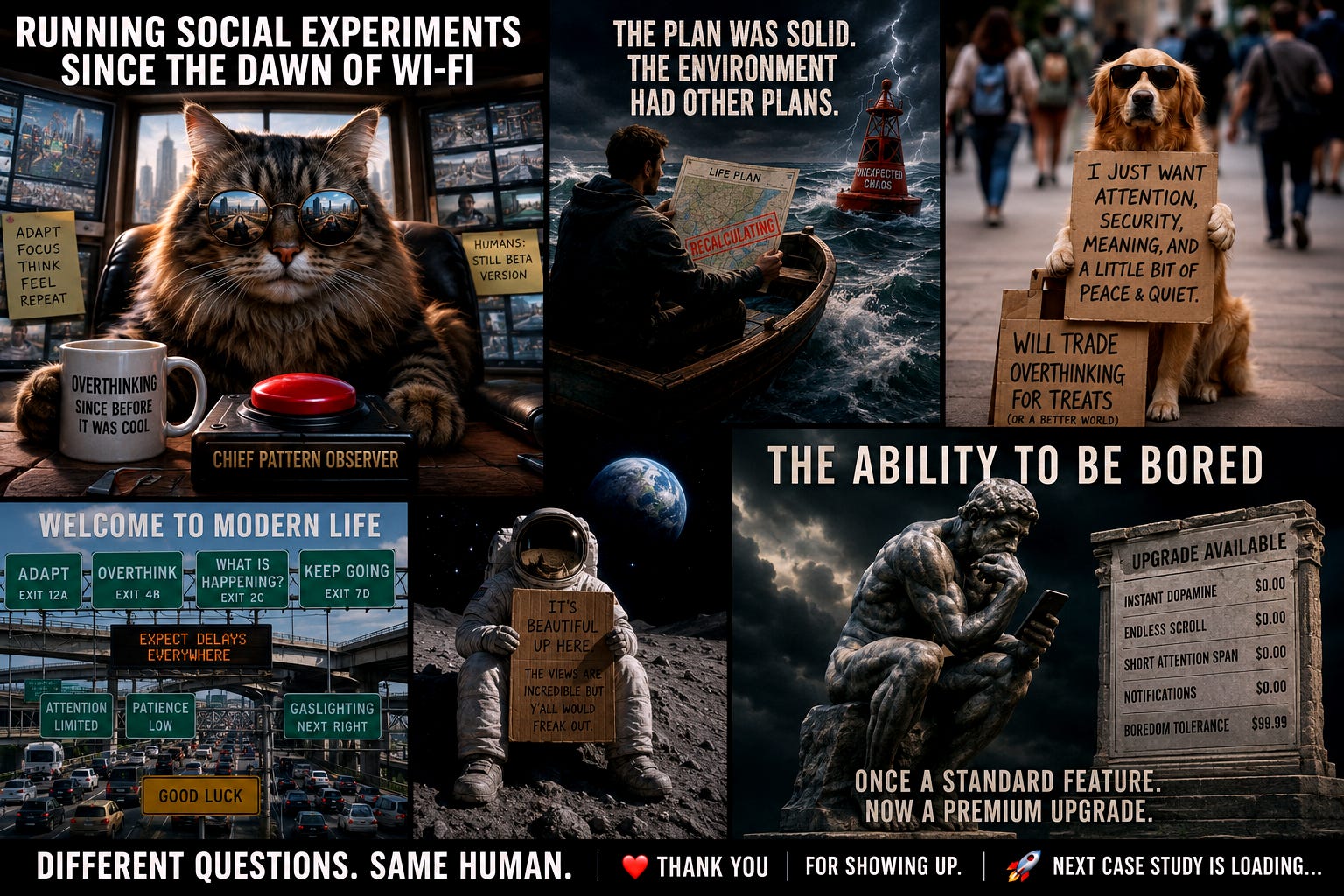
Nobody Said
Across fourteen questions and hundreds of responses, certain answers showed up over and over again.
Patience. Attention. Empathy. Judgment. Critical thinking. Community. Discernment. Responsibility. Boredom.
Other answers barely appeared at all.
If you asked most of us what modern society talks about constantly, you’d probably get answers like:
Technology. AI. Money. Productivity. Career advancement. Personal branding. Optimization. Growth. Hustle culture. Metrics. Algorithms.
Yet those weren’t what kept getting brought up.
In fact, I repeatedly asked questions where those answers would have made perfect sense.
“What skill has become mandatory for modern life?”
Nobody formed a support group for spreadsheet proficiency.
“What human ability is becoming optional?”
Nobody said PowerPoint.
“What skill are we losing?”
Nobody panicked about forgetting pivot tables.
Rude considering how much time we’ve all spent staring at them.
Instead, the conversation kept finding its way back to human capacities.
I asked about convenience.
The answer was patience.
I asked about modern life.
The answer was boredom.
I asked about skills.
The answer was empathy.
I asked about civilization.
The answer was judgment.
That’s when I realized something.
Most of you weren’t answering the literal question.
You were answering the question underneath the question.
Interesting.
If this project had simply become a discussion about AI, technology, politics, or economics, the findings wouldn’t be particularly surprising.
We argue about those things every day.
I was surprised how often many of you redirected the conversation back toward human beings.
Almost as if you were saying:
“Yeah, technology is changing.”
“But that’s not what I’m paying attention to.”
The thing y’all are paying attention to appears to be attention itself.
Judgment, patience, empathy, and critical thinking.
The capacities that allow us to navigate everything else.
That’s a very different conversation.
I think it’s the most important discovery from the entire project.
It suggests we may not be primarily worried about what civilization is building.
We could be worried about what civilization is shaping.
One is about infrastructure. The other is about people.
One is about tools. The other is about the humans using them.
And if the responses are any indication, a surprising number of you seem less concerned about whether the future becomes more advanced and more concerned about whether humans retain the capacities needed to navigate it.
That’s a much deeper concern than most headlines ever acknowledge.
Nobody knew where the questions were going or what future questions would be asked or what patterns I was looking for.
Yet somehow complete strangers kept independently pointing toward the same concerns.
Which means one of two things is happening.
Either we stumbled into the same conversation.
Or there really is something here worth paying attention to.
Tools tend to get all the headlines.
Human beings live with the consequences.
The comments section seemed far more interested in the second part.
The Weird Part
Isn’t that you answered the questions.
It’s how often you independently arrived at the same territory.
None of you knew what tomorrow’s question would be.
Nobody knew what patterns I was tracking.
And this wasn’t a collaboration.
Yet patience, attention, empathy, and critical thinking all kept showing up.
That’s weird.
The internet gets blamed for a lot of things.
One thing it revealed is that millions of us can compare notes in real time.
For all its flaws, that’s what happened here.
A few hundred strangers looked at the same world from different angles and kept describing surprisingly similar pressures.
That’s not proof but it’s not nothing either.
One person noticing something can be dismissed.
Ten people noticing it becomes interesting.
A hundred of us noticing becomes difficult to ignore.
Especially when we weren’t trying to arrive at the same answer.
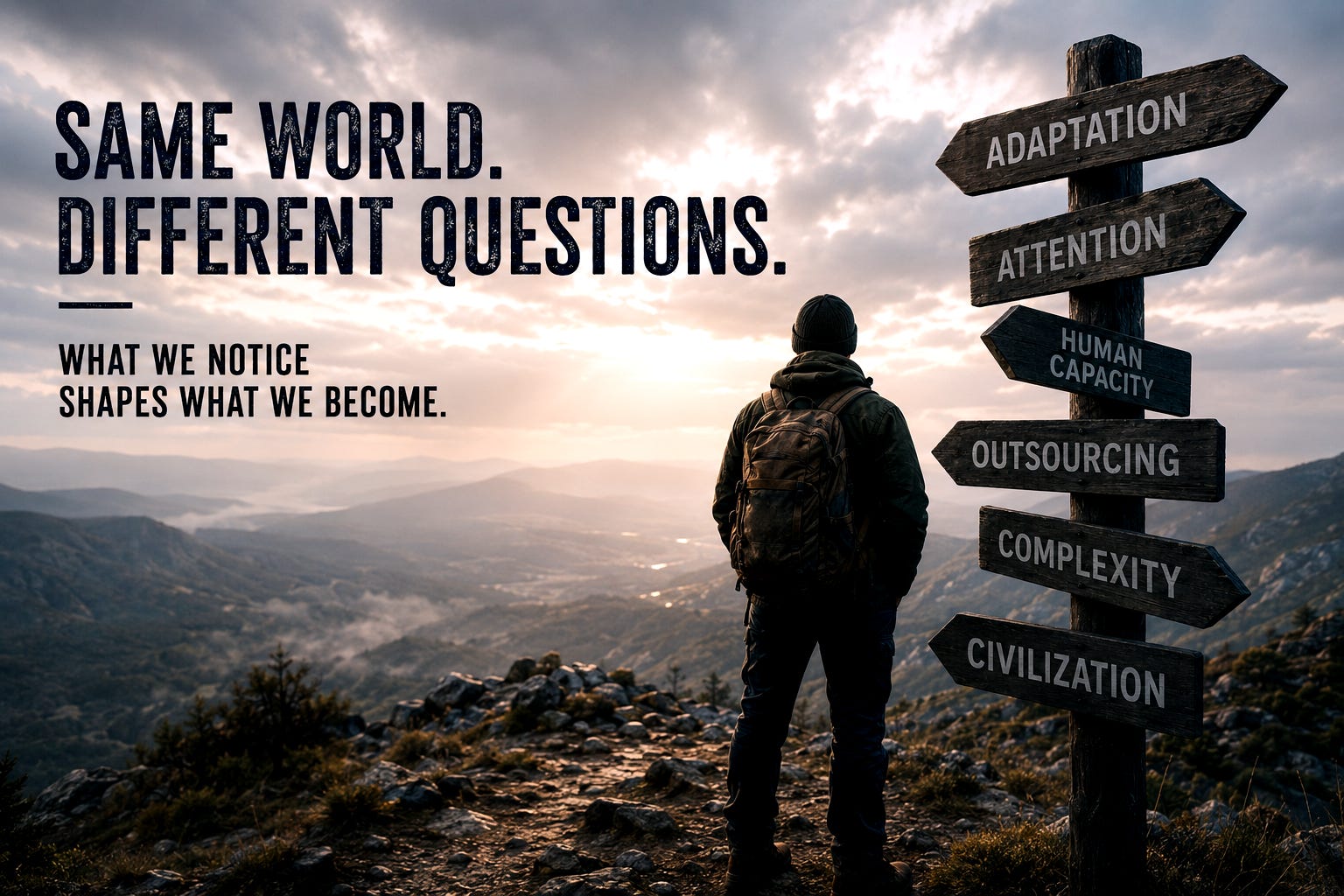
What The Comments Were Actually Saying
When I started this project, I thought I was collecting answers.
Now looking back, I think I was collecting signals.
The questions changed every day.
The answers kept pointing at the same things.
Adaptation. Attention. Critical thinking. Empathy. Judgment. Community. Responsibility. Discernment. Patience. Not occasionally. Repeatedly.
Independent readers answering independent questions kept independently arriving in the same neighborhood.
That doesn’t automatically mean they’re right.
It doesn’t mean civilization is collapsing, it doesn’t mean technology is evil, and it doesn’t mean we’ve entered the apocalypse sponsored by smartphone notifications and AI chatbots.
What it does mean is that a surprising number of you appear to be noticing the same pressures.
That matters because one person noticing something is an opinion.
Hundreds of you independently noticing similar things begins to look more like a pattern.
One of the biggest surprises from this project is that very few of you appeared interested in talking about technology itself.
Even when the questions created opportunities to do so.
Instead you kept talking about human beings.
What we’re gaining.
What we’re losing.
What we’re forgetting.
What we’re outsourcing.
What we’re adapting to.
What we’re normalizing.
What we’re rewarding.
What we’re no longer teaching.
That’s not where I expected this project to go.
I thought I was asking questions about society.
The comments section responded with a missing persons report for human capacities.
Admittedly, that is not the direction I saw this going.
The deeper I got into the responses, the more one possibility kept showing up.
It’s possible we aren’t primarily worried about technological change.
Maybe you’re worried about whether the traits that helped humans navigate previous eras are still being developed in the current one.
Maybe you’re worried about attention, judgment, patience, empathy, community or you’re worried about what happens when environments change faster than the habits that once helped us make sense of them.
I don’t know.
But many of you seem to be pointing in that direction.
Strangely enough, none of these concerns exist in isolation.
Attention affects critical thinking.
Critical thinking affects judgment.
Judgment affects decision making.
Decision making affects responsibility.
Responsibility affects trust.
Trust affects community.
Pull on one thread and eventually the entire sweater starts trying to leave the conversation. Both inconvenient and a decent metaphor for civilization.
That’s the biggest thing I learned from this project. The responses weren’t really about technology, politics, education, AI, productivity, or convenience.
Those things showed up but they weren’t the center of gravity.
The center of gravity was human capacity.
Again and again, the responses returned to the same basic question:
What kind of human does this environment produce?
Every civilization produces certain strengths and certain weaknesses.
Every environment rewards certain traits and neglects others.
The question isn’t whether modern life is changing us, as it clearly is.
The question is:
Into what though?
Not what kind of technology.
Not what kind of economy.
Not what kind of platform.
What kind of person?
That’s the question worth paying attention to, that I kept finding underneath the answers.
Civilizations don’t just build infrastructure. They build incentives, habits, expectations, environments, and environments tend to produce patterns.
Which brings us back to where this started.
I wasn’t trying to prove anything. Nor, was I testing a theory. I was truly curious what you would notice if nobody handed y’all the conclusion first.
Apparently the answer is:
A lot.
More importantly, many of you appear to be noticing the same things.
That doesn’t mean we’ve found the final answer.
If anything, I think we’ve found better questions.
Judging by how many of you asked for another round, I have a feeling we’re just getting started.
Stay tuned.
Until the next Pattern Project, pay attention to what others independently keep pointing toward.
Most signals show up long before anyone agrees on what they mean.
That's usually why they're called signals and not conclusions.
A huge thank you to everyone who subscribed, donated, shared, restacked, commented, and participated in this project.
What started as a series of weird questions somehow turned into one of the most interesting projects I’ve done on Substack.
I genuinely had no idea where it was going when we started.
Turns out a lot of y’all had some things to say. LMFAO
The comments, observations, disagreements, jokes, stories, and insights are what made this work.
This was a blast to build and I hope you enjoyed participating in it as much as I enjoyed putting it together.
The response has been far bigger than I expected, which means The Pattern Project continues.
WOOT WOOT
I’m already working on the next case study.
Stay tuned.
The Questions Asked
Question #1:
Question #2:
Question #3:
Question #4:
Question #5:
Question #6:
Question #7:
Question #8:
Question #9:
Question #10:
Question #11:
Question #12:
Question #13:
Question #14:
Brilliant. "We know too much about nothing." Which of course crowds-out the ability to know and understand "something."
Brilliant project loved you thoughts and insights!!