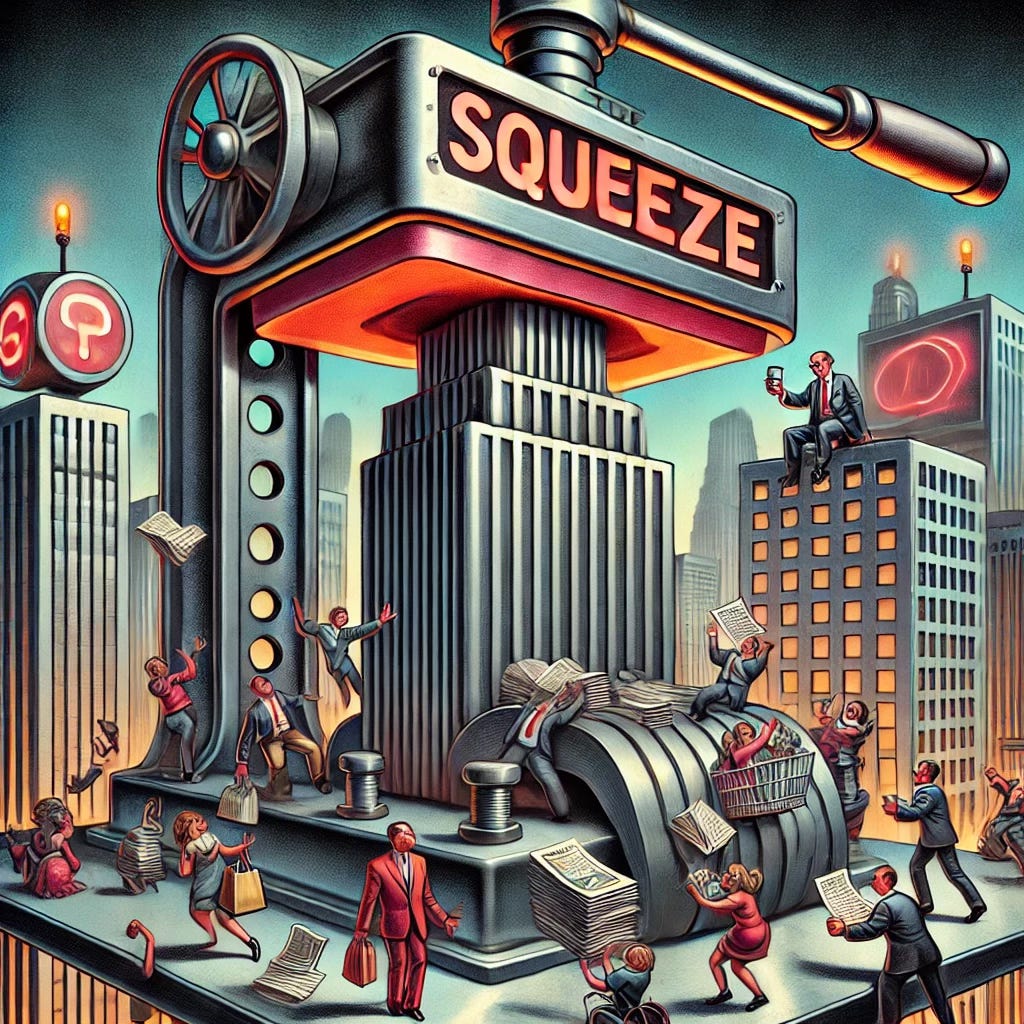
The Squeeze

So apparently it’s not just you.
If your rent jumps, your insurance adjusts, your grocery receipt humbles you, your tax estimate laughs, and your savings don’t stretch like they used to…
You’re inside a squeeze.
A structural compression.
Let’s talk about it like the grown fucking adults we are.
The Squeeze happens when:
• Cost floors rise
• Wage growth lags
• Risk shifts downward
• Administrative complexity expands
• Gatekeeping intensifies
• Stability decreases
• Cushion shrinks
ALL AT THE SAME TIME.
Across countries.
Different flags. Same physics.
Pattern #1: Rising Cost Floors
Not explosive. Just persistent.
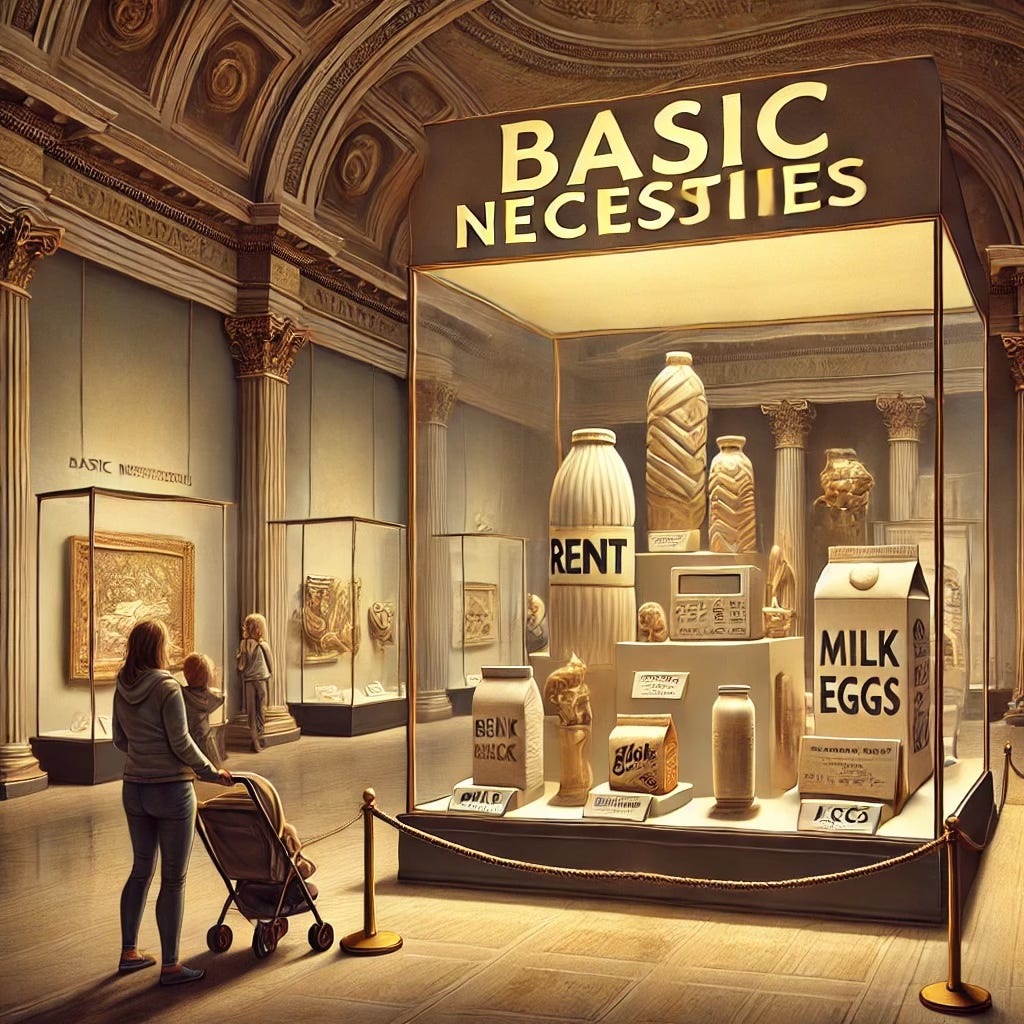
Housing absorbs more income.
Insurance premiums inflate.
Food prices fluctuate unpredictably.
Utilities rebalance upward.
Healthcare invents new adjectives.
Nothing crashes.
Nothing doubles.
It just creeps.
The floor of survival keeps lifting while your ceiling stays still.
That’s maintenance cost increasing inside complex systems.
And maintenance always gets paid first.
Whether you can afford it or not.
Pattern #2: Wage Elasticity Show
Wages increase.
Technically.
On paper.
But nowhere near fast enough to keep up with fixed costs.
So you feel like you’re running harder just to remain level.
It’s not poverty.
This is compression.
The middle class treadmill:
Run faster → Stay still.
Pattern #3: Risk Redistribution
Macro risk? Absorbed.
Banks stabilized.
Industries subsidized.
Markets protected.
Micro risk?
That’s you now.
Contract work.
Variable hours.
Gig layers.
Credential stacking.
Endless proving.
Risk moved downward.
Pattern #4: The Compliance Economy
Why does everything require three portals, two verifications, and an identity ritual?
Because complexity makes money and spreads liability.
More regulation.
More oversight.
More documentation.
More qualifications.
Entire industries now exist to help you navigate systems that used to be simpler.
You are not disorganized.
The maze got bigger.
And complexity becomes a moat.
Pattern #5: Credential Inflation
Entry level now requires:
5 years experience.
3 certifications.
And the emotional resilience of a Himalayan monk.
Why?
Institutions are reducing liability.
When liability rises,
gatekeeping rises.
Mobility narrows.
Upward movement stalls.
Compression deepens.
Pattern #6: Time Horizon Shrinkage
Policies rotate faster.
Rules shift more often.
Subsidies appear and disappear.
Interest rates swing.
Planning feels fragile.
So people shorten their horizon.
You plan the month.
Not the decade.
Time itself starts to feel compressed.

The Squeeze is not:
• The end of capitalism
• The end of democracy
• A secret master plan
• An apocalypse
• A guaranteed collapse
It is:
• A rebalancing phase
• A margin contraction cycle
• A system under constraint
• A volatility adjustment
Systems don’t wake up evil.
They optimize.
And when they optimize under constraint, friction increases.
Is This New?
No.
Compression phases have happened before:
1970s stagflation.
Post war debt compression.
Late 1800s industrial transition.
Post 2008 stagnation.
But this one feels different.
Because it’s synchronized.
This is the first digital age squeeze where multiple economies tighten at once while everyone watches in real time.
Different symptoms.
Same pressure.
In emerging markets it looks like volatility.
In developed economies it looks like stagnation.
In resource heavy nations it looks like price hikes.
In debt heavy nations it looks like austerity pressure.
Different surfaces.
Same compression physics.
The Institutional Lag Problem
Most institutions were designed during expansion eras.
Education systems.
Housing models.
Career ladders.
Retirement assumptions.
Family expectations.
But the environment shifted to constraint.
The systems didn’t.
So individuals are expected to behave like it’s still expansion…
while living inside compression.
That mismatch is what people are actually feeling.
The Generational Misalignment
Some people built during tailwinds.
Others are building during headwinds.
That’s timing.
Expansion eras reward increase and optimism.
Compression eras reward resilience and flexibility.
So expectations built in expansion don’t hold up in constraint.
That’s why the frustration feels generational.
The Real Psychological Shift
The Squeeze doesn’t just tighten money.
It tightens imagination.
When margin shrinks:
• You delay having kids.
• You delay moving.
• You delay quitting.
• You delay starting.
• You delay risking.
Caution becomes the default.
And a cautious population feels stable.
But also trapped.
Behavior shifts before policy shifts.
Compression changes culture first.
The Damage of Compression
The hardest part isn’t the money.
It’s the cognitive dissonance.
You did what the brochure said.
You followed the path.
You didn’t make reckless choices.
And yet stability keeps drifting further away.
Compression doesn’t just tighten budgets.
It erodes trust in cause and effect.
That’s why people feel disoriented.
Not just stressed.
Disoriented.
Because the inputs stayed the same…
but the rules changed.
And the outputs stopped matching the effort.
We were promised:
Work hard → Stability.
Instead we got:
Work hard → Maintain.
We were promised:
Optimization → Freedom.
Instead we got:
Optimization → Subscription fees.
We were promised:
Tech → Efficiency.
Instead we got:
Tech → Another login.
No one directly lied.
They just never corrected the verbiage used.
Question for y’all…
When was the last time you felt your margin increased without adding more work?
Sit with that.
If this helped you understand what’s happening,
the paid section is where we talk about what to actually do about it.
Because seeing the system helps.
Knowing how to move inside it helps even more.
